As you walk through the developing sites in the city today, you would notice a silent shift taking place. The traditional pillars of infrastructure like steel, wood and concrete are progressively making room for a new material that’s a smarter, greener and more economical choice for the future. In their place, a new material is finding space on building sites, factory floors and public infrastructure – Fibre Reinforced Polymer (FRP), which is proving to be smarter, greener and far more economical in the long run.
As India moves steadily toward carbon-neutral goals, it’s worth asking a simple question – How much does a material really contribute to a greener future—and how much does it quietly cost us over time?
A Smaller Carbon Footprint at Every Step
Every traditional material comes with environmental baggage.
Steel requires mining, smelting and enormous amounts of energy. Wood demands forest resources and frequent replacement. Concrete production is one of the world’s largest sources of CO₂ emissions.
FRP breaks this pattern.
It’s lighter, resulting in less fuel consumption during transportation.
It lasts longer, resulting in fewer or zero replacements.
It resists rust, rot and decay, resulting in no repeated chemical treatments, no repainting and no protective coatings.
Thanks to low-energy manufacturing and long service durability, FRP can cut lifecycle carbon emissions by 30–60%, especially when used for doors, gratings, tanks, louvres and manhole covers.

The Long-Term Advantage of FRP – Low Cost, No Maintenance
At first glance, FRP may appear more premium than metal or wood. But that gap closes surprisingly fast. Across hotels, industries, municipal projects, and residential complexes, FRP installations typically recover their cost in a few years, primarily because they don’t require ongoing maintenance. No rust treatment. No termite sprays. No polishing. No repainting. And the best part is that FRP has no scrap value, which is a major relief for public infrastructure constantly battling theft.
In simple terms: the less you maintain, the less you spend. What truly sets FRP apart is the ease of life it offers.
It doesn’t rust like steel.
It doesn’t bend and swell like wood.
It doesn’t chip or crumble like concrete.
FRP retains it’s form in sun, rain, humidity and salt-laden coastal winds—conditions that Goa knows all too well. Its inherent properties like corrosion-proof, moisture-resistant, chemically stable, UV-resistant make it one of the few materials that genuinely perform in every season.
Where EP Biocomposites Creates Real Green Gains
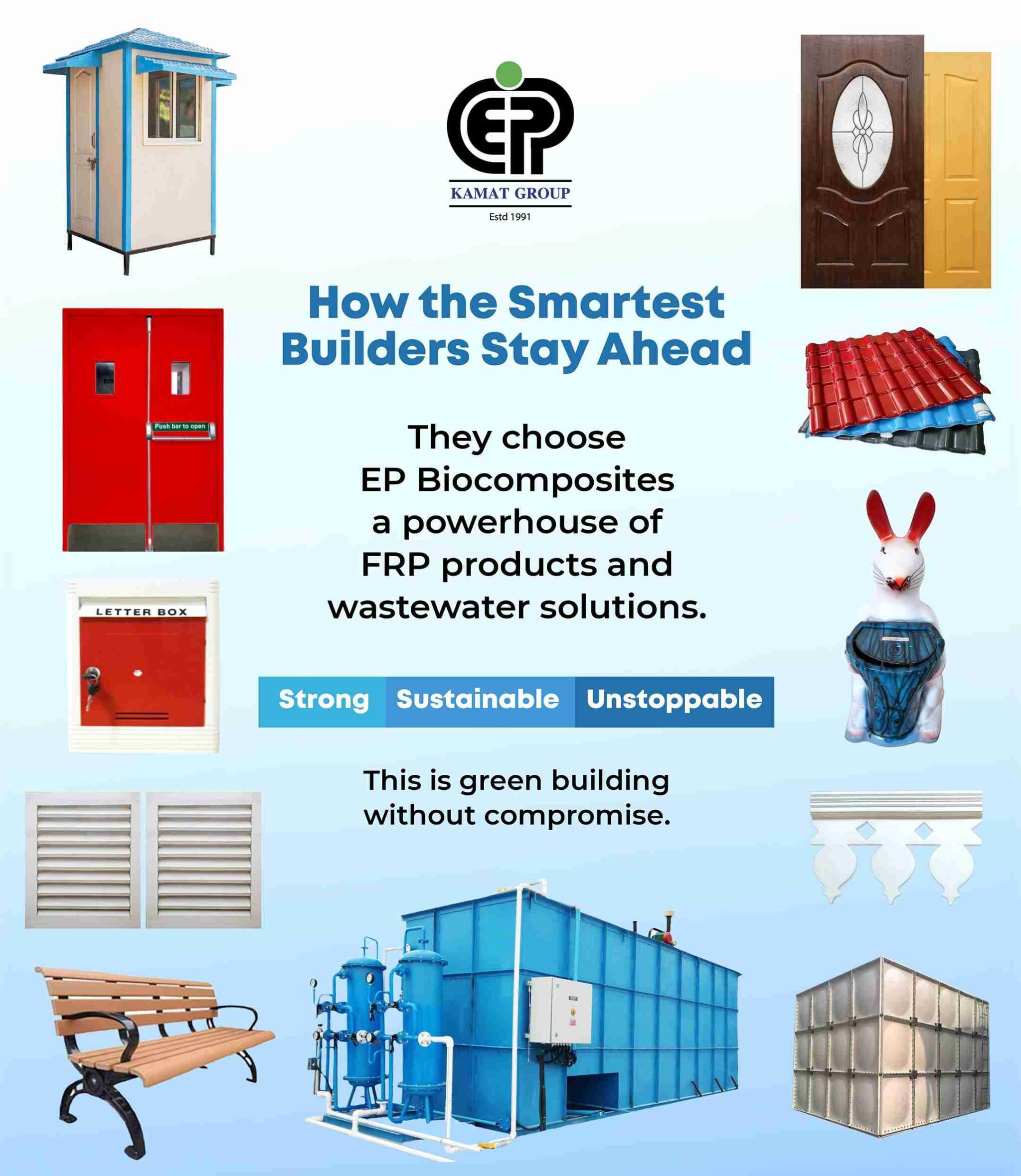
EP Biocomposites has championed FRP manufacturing, not as an alternative but as an upgrade. Our FRP products like doors, tanks, security cabins, manhole covers, gratings, fencing, garden benches, biodigesters, etc. are engineered for Indian conditions and India’s sustainability targets.
By replacing rust-prone metal components and transitioning to non-corrosive FRP products, builders and industries are reducing their carbon emissions. Thus, reducing their recurring expenses without compromising on the quality and performance.
The Future Belongs to Low-Impact, High-Performance Materials
Switching to FRP isn’t just a material upgrade, it’s a climate choice, a financial strategy and a smarter long-term move. Because when sustainability becomes measurable, progress stops being a slogan and becomes a responsibility. At EP Biocomposites, we are committed to helping India build that future, one durable, eco-smart FRP solution at a time.