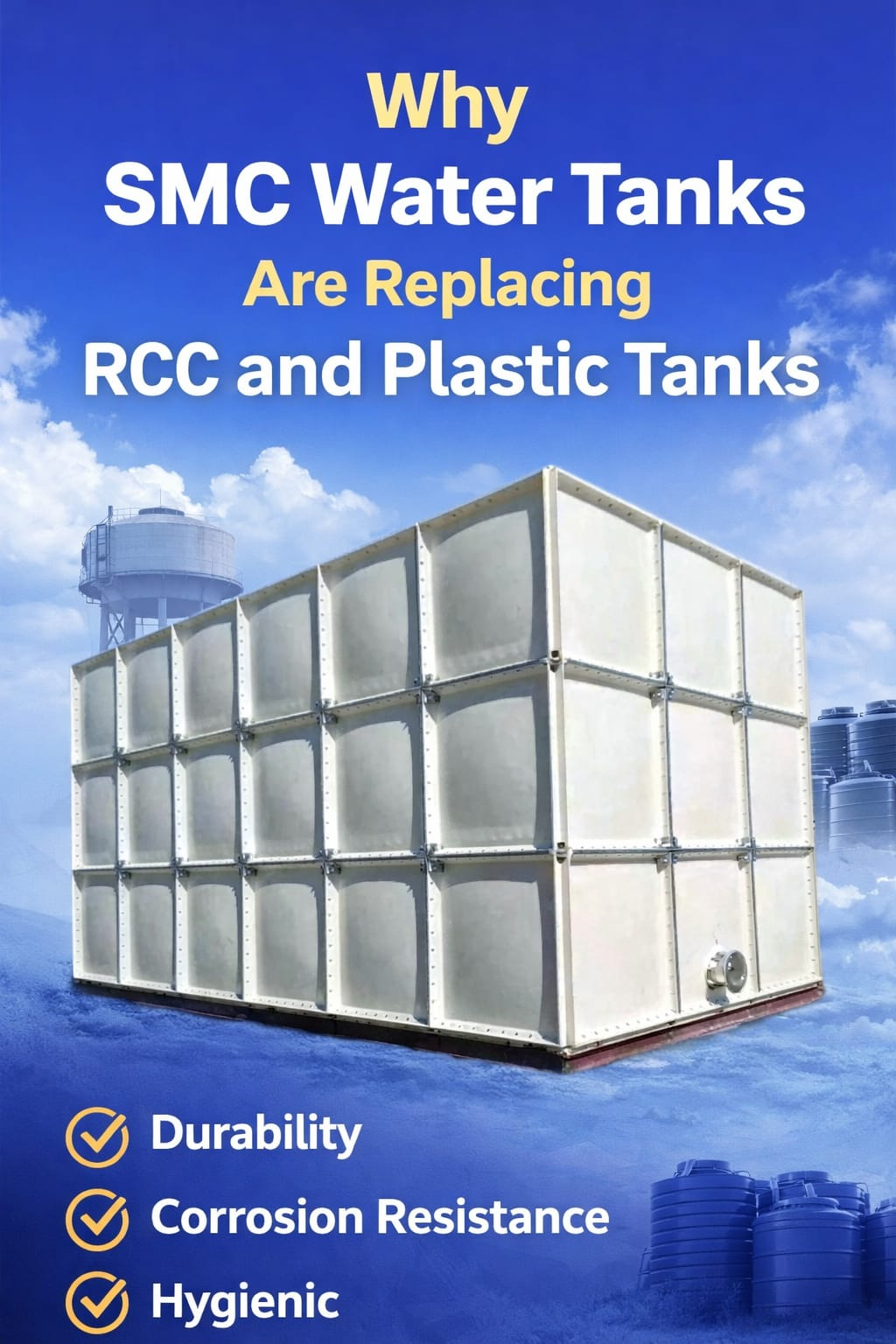
Water storage is no longer something that can be treated as a routine utility in a building. It has a direct bearing on hygiene, ongoing upkeep and the structure’s long-term performance. With urban density increasing and water quality becoming a larger concern, conventional storage practices are now being examined more carefully than before.
That’s why SMC water tanks are steadily replacing RCC and plastic tanks across residential, commercial and industrial projects.
The Hidden Limitations of RCC and Plastic Tanks
For decades, RCC tanks were considered permanent. But “permanent” does not always mean problem-free.
With age, RCC tanks often begin to show fine cracks, minor seepage and wear on the inner surfaces. At first, these may seem insignificant, but over time they can contribute to contamination, algae formation and gradual weakening of the structure — usually becoming apparent only when repair work turns expensive and disruptive.
Plastic tanks became as a lighter and more economical option. While they addressed certain concerns, long-term exposure to sunlight, expansion and deformation in high temperatures and hygiene limitations in humid conditions affect their durability. In today’s context, where infrastructure is expected to perform reliably for years, these limitations are becoming harder to ignore.
The Shift Toward Engineered Storage: SMC Water Tanks
SMC (Sheet Moulding Compound) water tanks represent a structural upgrade — not just a material change. SMC tanks are manufactured using fibre-reinforced composite panels that are factory-made for consistency and strength. Their modular construction makes them resistant to corrosion and suitable for long-term use in demanding conditions. On the hygiene front, the smooth, non-porous inner surfaces help minimise algae formation and bacterial buildup, making them appropriate for safe potable water storage.
Their panel-based design enables:
*Faster installation
*Easy transportation to elevated or restricted sites
*Flexible capacity expansion
*Minimal structural load on buildings
Structurally, SMC tanks offer superior resistance to corrosion, temperature fluctuations and even seismic stress compared to RCC or plastic alternatives. The result is lower maintenance, longer service life and reduced lifecycle costs. In simple terms cleaner water, stronger performance and fewer long-term surprises.
Why the Shift Is Accelerating
Infrastructure decisions today are being made with a longer view. Instead of focusing solely on initial expenditure, stakeholders are considering how a system will perform year after year. The accumulated cost of maintenance, repairs and operational disruptions can easily outweigh any early price advantage. As a result, opting for a durable, well-engineered storage solution from the beginning is widely seen as a more sensible and economically sound decision.
Projects that are transitioning to engineered storage are smartly reducing their exposure to future performance and maintenance risks. By making that shift early, they minimise the chances of recurring leak repairs, structural modifications, hygiene-related concerns and avoidable operational disruptions later on.
A Smarter Choice for a Water-Conscious Future With EP Biocomposites
If a project is intended to serve for decades, it makes sense to consider whether materials with known ageing and deterioration issues can truly support that long-term expectation. SMC water tanks are not a trend — they are a structural evolution in how buildings manage their most vital resource.
At EP Biocomposites, our SMC water tanks are developed with long-term performance as the priority. We emphasise structural stability, hygiene, and modular flexibility so that storage systems can expand with increasing demand without affecting safety or reliability.
Our water storage solutions are in use across residential complexes, hotels, hospitals and industrial facilities where reliability and low maintenance are non-negotiable. The modular design allows quicker installation, less site disruption and consistent factory-built quality thus making them practical for both new constructions and upgrade projects.
At EP Bioicomposites we believe water infrastructure should not be the weakest link in a building’s lifecycle.